
Rooftop PV risk starts with the roof
Integrating passive fire protection into new and refurbished roofs designed for PV.
For insurers and risk engineers, rooftop PV starts with the roof. Both new construction and refurbishment require the right combination of structural capacity, service life and fire performance.
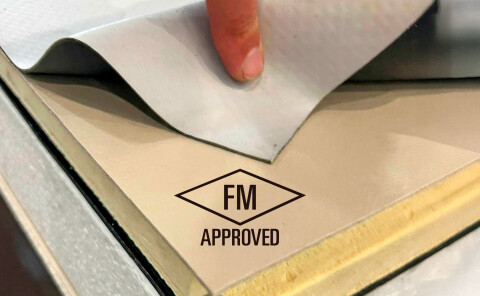
AllShield BarrierSheet provides a lightweight mineral fire barrier beneath new waterproofing, supported by FM Approvals and independent PV fire testing.

Why this matters for engineering review
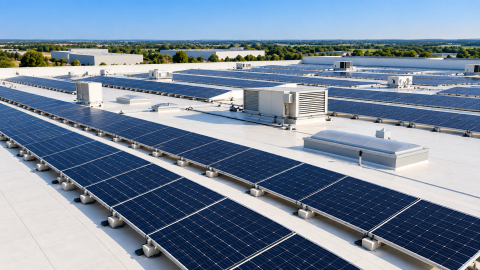
Rooftop PV installations introduce additional loads, potential ignition sources and changes to fire development. High-quality components, installation practices, inspections and maintenance can reduce the probability of ignition but cannot eliminate it.
Risk engineering must therefore address both ignition prevention and consequence limitation. If ignition occurs, the fire performance of the complete roof and PV assembly influences whether underlying roof materials become involved and how far damage may extend into deeper layers.
For new construction, these considerations can be integrated from the design stage. For existing buildings, they must be assessed alongside structural capacity, roof condition and the remaining service life of the waterproofing membrane.
Assess the roof before approving the PV system.
Three roof conditions, three assessment pathways
New construction and existing commercial roofs present different opportunities and constraints. The appropriate approach depends on structural capacity, roof composition, intended service life, documented fire performance and insurer requirements.
Route 1. The existing roof is suitable for PV
An existing roof may be retained when it has sufficient structural capacity, adequate remaining service life relative to the planned PV installation and documented fire performance acceptable to the insurer. The assessment must also address PV mounting, wind loads and maintenance access.
Where fire performance cannot be adequately demonstrated or the remaining roof service life is insufficient, further investigation or refurbishment should be considered.
Route 2. New construction or roof refurbishment with AllShield BarrierSheet
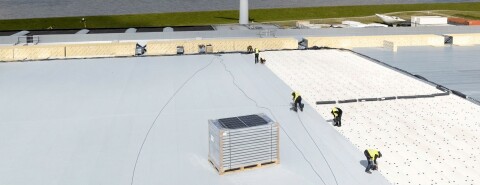
For new buildings, integrating passive fire protection from the design stage allows the roof and PV installation to be developed as a complete assembly. For existing buildings, refurbishment provides an opportunity to address ageing waterproofing, remaining service life and fire performance before PV is installed.
In both situations, AllShield BarrierSheet provides a lightweight mineral fire barrier beneath a new waterproofing membrane. Its performance is supported by FM Approvals for specified assemblies and independent rooftop PV fire testing.
Route 3. Retaining the existing waterproofing
Where an existing roof membrane is in good condition and retaining it offers a clear practical advantage, AllShield Blue may be considered for selected applications. Suitability depends on membrane compatibility, roof condition, application requirements, local climate and the relevant approval conditions.
This alternative is subject to project-specific technical review.
Design or upgrade your roof for PV
Whether constructing a new commercial building or refurbishing an existing roof, integrating passive fire protection before installing PV allows fire performance, structural loading and service life to be considered together.
AllShield BarrierSheet is a lightweight mineral coverboard with a nominal thickness of 2.5 mm and a weight of approximately 3 kg/m². Installed beneath a new waterproofing membrane, it provides a passive fire barrier while adding relatively little permanent load to the roof.
For new construction, BarrierSheet can be specified as part of the roof design from the outset. For refurbishment, it can be incorporated when replacing the existing waterproofing membrane, allowing the upgraded roof to be designed around the intended PV service life.
When combined with suitable insulation, waterproofing and a compatible PV mounting system, BarrierSheet can form part of a consequence-limiting design. Its purpose is to restrict direct flame penetration into deeper roof layers and reduce the potential consequences of a rooftop PV fire.
BarrierSheet has FM 4470 and FM 4478 Approved status for specified roof assemblies. Its performance is further supported by independent PV fire testing. The suitability of the complete assembly must be verified for each project.
Independent PV fire testing: protection after ignition
Independent research testing by ZAG investigated the performance of AllShield BarrierSheet in four roof configurations incorporating combustible materials and rooftop PV modules. The tests included both mid-scale and large-scale assemblies, different insulation materials and different insulation thicknesses.
The test programme used enlarged wood-crib ignition sources beneath the PV modules. When a single enlarged crib did not produce sufficient fire spread, two enlarged cribs were used. ZAG assessed these larger ignition sources as having a higher heat release rate than the nominal 15 kW burners used in comparable tests.
Across all four configurations, BarrierSheet prevented direct flame penetration into deeper roof layers. The tests also documented heat transfer and localised thermal damage beneath the barrier, including EPS melting, PIR deformation and evidence of PIR decomposition.
Four tested configurations
| AS-1 | Bitumen over 100 mm EPS | Single module, S-Dome mounting | No direct flame penetration. Heat exposure caused localised EPS melting. |
| AS-2 | 60 mm PIR over bitumen and 100 mm EPS | Single module, S-Dome mounting | No direct flame penetration. PIR deformation and evidence of decomposition were observed. |
| AS-3 | Bitumen over 100 mm EPS | Multiple modules, D-Dome mounting | No direct flame penetration. Localised damage included extensive EPS melting and bitumen fused to the underlying plasterboard. |
| AS-4 | 120 mm PIR | Multiple modules, D-Dome mounting | No direct flame penetration. PIR deformation and thermal damage were observed. |
The tests incorporated PVC waterproofing membranes, with S-Dome single-sided PV mounting in the mid-scale tests and D-Dome multi-module mounting in the large-scale tests.
These were research tests designed to investigate fire behaviour beneath PV arrays, not classification tests. The findings demonstrate the contribution BarrierSheet can make to consequence limitation in the tested configurations. They also show that preventing direct flame penetration does not eliminate heat transfer or thermal damage to underlying materials.
Insulation type, thickness, joints and attachment details remain important aspects of the complete roof design.
Reference: ZAG report 448/25-560-1-EN, August 2025.
FM approval and RoofNav documentation
FM Approvals and RoofNav provide an established framework for evaluating specified roof assemblies, including configurations with rooftop PV. For FM-insured projects, the relevant listing must be checked against the complete proposed construction rather than relying on the approval of an individual component.
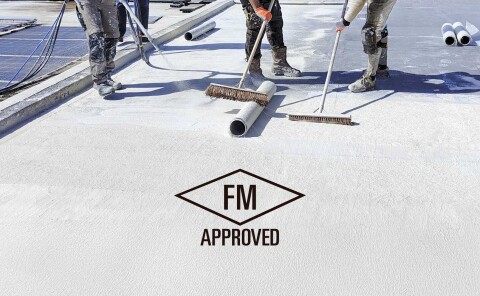
AllShield BarrierSheet has FM 4470 and FM 4478 Approved status under FM Approvals report PR472014, dated 11 December 2025.
FM 4470 addresses roof assembly performance, while FM 4478 specifically covers roof-mounted rigid photovoltaic module systems. This PV-specific approval is particularly relevant to insurers because BarrierSheet is included in a listed roof and PV assembly rather than being documented solely as an individual coverboard.
RoofNav assembly 568563-0-0 documents a configuration incorporating a steel deck, FM Approved insulation, a 2.5 mm BarrierSheet coverboard, mechanically attached Sarnafil TS 77 waterproofing, a Sika SolaRoof mounting system and specified FM Approved PV modules.
The assembly has a listed roof wind uplift rating of 1-90. The current RoofNav listing provides the complete assembly details and applicable performance ratings.
Other roof configurations and any deviations from the listed assembly require separate technical verification and project-specific review. AllShield can provide the relevant documentation and help identify which aspects of a proposed roof assembly require further assessment.
Additional European fire test evidence
European projects may require external fire performance documentation according to EN 13501-5 using the applicable CEN/TS 1187 test method.
BarrierSheet has been tested by Efectis according to CEN/TS 1187:2012, Test 1, in a specified roof configuration incorporating Rhenofol CV waterproofing, BarrierSheet above and below 140 mm PIR insulation and a steel deck.
The test report provides results for assessment under EN 13501-5. A formal BROOF(t1) classification for the relevant configuration should be established from the corresponding classification report.
External fire exposure testing and PV-specific fire testing assess different fire scenarios. Both may be relevant to a complete roof and PV assessment.
Reference: Efectis report 2025-Efectis-R000982, July 2025.
Wind uplift and mechanical loads with PV
Rooftop PV changes the loads and load paths acting on a roof. Wind uplift, ballast, local point loads and the interaction between the mounting system and the roof assembly must be considered during the engineering assessment.
At approximately 3 kg/m², BarrierSheet adds relatively little permanent load to a new or refurbished roof. However, its low weight does not remove the need to verify the roof's structural capacity, insulation performance, attachment system and project-specific wind loading.
Where FM is the reference framework, the proposed configuration must be checked against the applicable RoofNav documentation, including fastening requirements and detailing at roof edges, corners, penetrations and transitions.
Suggested wording for risk reports
Roof suitability assessment
The proposed rooftop PV installation should be assessed against the structural capacity, composition, condition and intended service life of the roof. For existing buildings, the remaining waterproofing service life must also be considered. The relevant fire performance and insurance requirements should be established before the final installation design is approved.
Passive fire protection for new construction and refurbishment
For new construction or roof refurbishment involving rooftop PV, consideration should be given to incorporating a lightweight mineral coverboard with documented non-combustible properties beneath the new waterproofing membrane.
The proposed assembly should be supported by fire test evidence of the complete roof assembly including rooftop PV modules, together with applicable FM Approvals documentation and verification of the intended construction.
The objective is to limit fire propagation into deeper roof layers and reduce potential fire consequences while minimising additional permanent roof loading. Final suitability and insurer acceptance remain subject to project-specific assessment.
Technical documentation for insurers and risk engineers
AllShield provides technical documentation to support the evaluation of BarrierSheet within defined roof assemblies. Available material includes FM Approvals documentation, RoofNav references, independent PV fire research and European external fire test evidence.
Get the BarrierSheet evidence pack
A consolidated technical reference bringing together the relevant FM documentation, independent fire test evidence, assembly information and key considerations for evaluating BarrierSheet in commercial rooftop PV projects.
Discuss a specific roof assembly
If you are assessing a new commercial roof or an existing rooftop PV project, share the proposed roof build-up, planned PV installation and relevant technical or insurance requirements. AllShield can review the available information and discuss how BarrierSheet may be integrated into a suitable roof design or refurbishment project.
Further technical insights
Explore our technical publications on rooftop PV fire behaviour, consequence-limiting design and the relationship between roof construction and PV installation.
Roof suitability first. Fire performance by design.
Commercial rooftop PV should be approached as a roof-system decision, not only as an energy project. AllShield develops mineral passive fire protection solutions that can be integrated into defined roof assemblies.
AllShield BarrierSheet is the standard approach for new construction and roof refurbishment requiring new waterproofing. AllShield Blue may be considered for selected applications where retaining the existing membrane offers a clear practical advantage.

Next step go to download page to download relevant documents.
Passive fire protection for new and refurbished roofs with PV
The right roof assembly for PV and documented fire protection
Flat roofs with solar PV require fire protection that considers the complete roof assembly. AllShield BarrierSheet is our standard solution for new construction and roof refurbishment, installed beneath a new waterproofing membrane. AllShield Blue is a specialist alternative for selected existing roofs where retaining the current waterproofing provides a clear practical advantage.
Request my risk scan