Discover our fire-protection solutions for roofs with PV
1-7-2025
AllShield BarrierSheet achieves BROOF(t1) classification in a defined roof assembly
A roof assembly incorporating AllShield BarrierSheet has achieved BROOF(t1) classification under EN 13501-5, supported by an Efectis classification report. The result provides documented external fire-performance evidence for a defined construction, relevant to commercial roof design and refurbishment.
An important milestone in documented roof fire performance
AllShield BarrierSheet has been incorporated into a roof assembly classified BROOF(t1) under EN 13501-5, following external fire testing and assessment by Efectis. The classification, documented in Efectis Classification Report 2025-Efectis-R000983, provides independent evidence of the external fire performance of a defined roof construction. For architects, roof consultants, building owners and insurers, this is an important addition to the technical documentation available when specifying roof systems that incorporate passive fire-protection measures.
Commercial flat roofs increasingly need to accommodate several design requirements simultaneously. Waterproofing performance, thermal efficiency, structural capacity and future solar PV installations must all be considered, often within constructions that contain combustible insulation such as PIR. Fire classifications provide a recognised way of demonstrating performance against specified exposure conditions, helping project teams select roof assemblies on the basis of documented evidence rather than assumptions about individual materials.
The BROOF(t1) classification represents an important milestone for BarrierSheet because it demonstrates the performance of a complete roof construction in which the product is incorporated. It is not a blanket classification of every roof containing BarrierSheet, nor does it mean that the product alone makes a roof non-combustible. The classification applies to the assembly and conditions identified in the Efectis report, and those conditions must be considered when using the result in a project specification.
What BROOF(t1) means
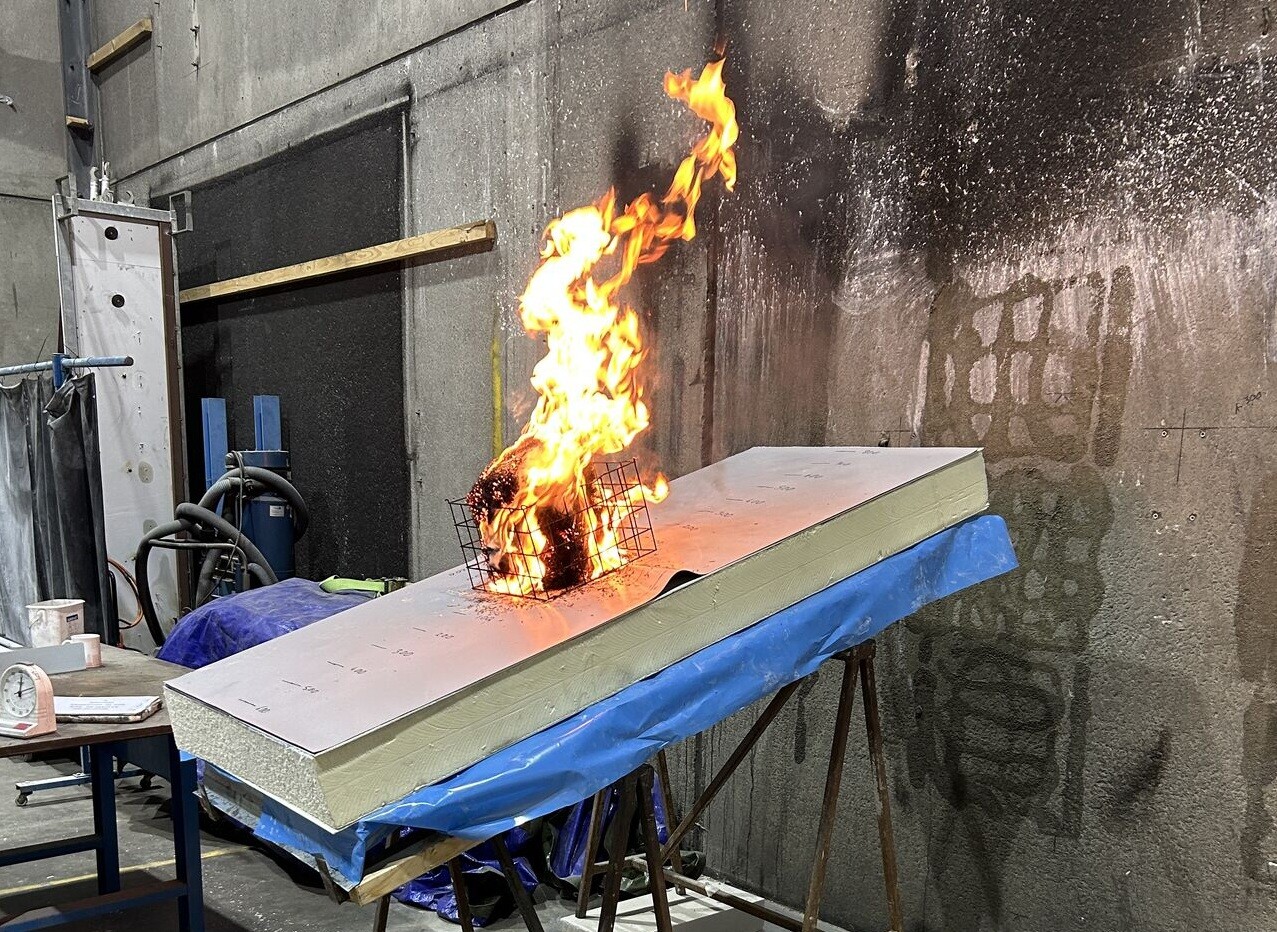
EN 13501-5 provides the European classification framework for the external fire performance of roofs and roof coverings. The BROOF(t1) classification relates to testing based on Test 1 of CEN/TS 1187, which uses a burning-brand exposure to evaluate specified aspects of roof fire behaviour. The classification provides a common technical reference for assessing roof constructions within the scope of the test method and the associated classification rules.
An important distinction is that BROOF(t1) is an external roof-fire classification, not a dedicated assessment of a fire originating beneath photovoltaic modules. A PV installation changes the geometry above the waterproofing membrane and can influence flame movement and heat transfer during a fire. Those conditions require their own technical consideration and cannot simply be inferred from a conventional external roof-fire classification. BROOF(t1) evidence therefore remains valuable, but its purpose must be understood accurately.
The roof construction assessed by Efectis
The Efectis classification covers a specified roof assembly incorporating a 1.5 mm PVC waterproofing membrane, BarrierSheet, 140 mm PIR insulation and a second BarrierSheet layer beneath the insulation. The documented construction includes a steel roof deck, with a stated roof slope range of 0–20 degrees. This arrangement is important because the fire performance belongs to the complete assembly, including the position and combination of its constituent layers.
The two BarrierSheet layers must not be overlooked when interpreting the classification. A roof containing only one BarrierSheet layer, a different waterproofing membrane or alternative insulation cannot automatically be described as covered by the same BROOF(t1) classification. The detailed report must be consulted to establish the applicable configuration, installation conditions and any permitted variations before the classification is used in a project specification.
The classified roof assembly
| Waterproofing membrane | 1.5 mm PVC | Upper waterproofing layer of the classified assembly |
| Upper separation layer | AllShield BarrierSheet | Positioned directly beneath the waterproofing membrane |
| Thermal insulation | 140 mm PIR | Insulation within the classified construction |
| Lower separation layer | AllShield BarrierSheet | Positioned beneath the PIR insulation |
| Supporting construction | Steel roof deck | Supporting construction within the documented assembly |
| Roof slope | 0–20° | Stated slope range of the classification |
| Classification | BROOF(t1), EN 13501-5 | External fire classification for the defined assembly |
Understanding the different forms of fire-performance evidence
| A1 — EN 13501-1 | Reaction-to-fire classification of the BarrierSheet material | Material classification, not the complete roof |
| BROOF(t1) — EN 13501-5 | External fire performance of a specified roof assembly | The construction and conditions defined in the Efectis classification |
| ZAG roof-PV fire testing | Observed direct flame penetration behaviour and thermal effects during defined roof-PV fire tests | The tested configurations and exposure conditions |
| FM Approval — FM 4470 / FM 4478 | Approval of specified roof and roof-PV assemblies incorporating BarrierSheet | The applicable listed assemblies and approval conditions |
What the classification means for commercial roof projects
For commercial roof projects, an independent fire classification is valuable because it gives designers and building owners a recognised technical basis for assessing a proposed construction. The BROOF(t1) result for the defined BarrierSheet assembly can support projects where external roof-fire performance is part of the design requirements. It also provides roofing contractors and consultants with specific documentation that can be reviewed alongside waterproofing specifications, structural calculations, thermal performance and other applicable project conditions.
This is especially relevant in European markets, including Germany, where external roof-fire performance is an important regulatory consideration. However, national building requirements and insurer acceptance depend on the applicable rules and the actual construction. A BROOF(t1) classification does not automatically establish compliance with every German or European building requirement, nor does it guarantee that a property with solar PV will be accepted for insurance. The responsible project team must establish which requirements apply and whether the classified assembly is suitable for the intended building.
A lightweight separation layer within the roof design
BarrierSheet contributes approximately 3 kg/m² and has a nominal thickness of 2.5 mm. These characteristics make it relevant for projects where available structural capacity, roof height and the integration of additional construction layers require careful consideration. On existing commercial buildings, the weight of new materials can be particularly important when refurbishment is planned together with the installation of solar PV, mounting structures or ballast.
The low weight of BarrierSheet is a product characteristic, not a substitute for structural assessment. The complete roof intervention must still be evaluated, including the supporting structure, retained roof materials, new waterproofing system and additional PV loads. Similarly, the use of BarrierSheet within a classified assembly does not establish that a different refurbishment arrangement will achieve the same classification. Selecting a suitable solution requires a balance between fire-performance evidence, structural feasibility, durability and the practical conditions of the project.
Different fire exposures require different evidence
Solar PV introduces an additional consideration because a fire beneath the modules can expose the waterproofing membrane to an environment that differs from the burning-brand exposure addressed by BROOF(t1). PV modules and mounting systems influence the space available for flame movement and heat transfer, while the presence of combustible insulation beneath the membrane makes the position of passive separation layers particularly relevant.
AllShield has therefore developed a broader technical evidence base for BarrierSheet. In addition to the Efectis BROOF(t1) classification, the material has an A1 reaction-to-fire classification under EN 13501-1. Independent roof-PV fire testing by ZAG has examined the behaviour of BarrierSheet in specific configurations, documenting its function against direct flame penetration into lower structural layers under the tested conditions. Those tests also identified thermal effects, making clear that direct flame separation does not necessarily eliminate heat transfer or damage beneath the layer.
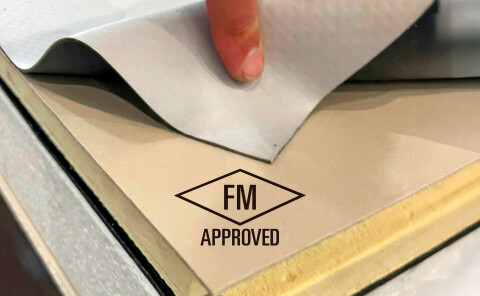
BarrierSheet is also included in defined FM Approved roof assemblies, including a specified roof-PV assembly under FM 4470 and FM 4478. These approvals relate to the complete listed construction and should not be confused with the Efectis external fire classification or the ZAG experimental programme. Together, these documents address different technical questions and can support project evaluation when each is used within its proper scope.
From test evidence to a defensible roof specification
The significance of the BROOF(t1) result extends beyond the classification itself. It demonstrates how a relatively thin mineral separation layer can be incorporated into a defined roof construction with independently documented external fire performance. For architects, roof consultants and building owners, this creates an additional specification option supported by formal classification evidence. The practical value lies in selecting the correct assembly, understanding its limitations and ensuring that the documentation matches the actual project.
For new buildings, this assessment can take place while the roof structure, insulation, waterproofing and planned PV installation are being designed together. For refurbishment projects, the condition and composition of the existing roof must first be established. Where an overlay is being considered, the project team should assess the suitability of the retained materials and determine whether the resulting construction falls within an existing classification or requires further technical evaluation. This approach avoids replacing a performance-based assessment with a general claim about a single product.
Request the technical documentation
AllShield can provide the relevant BarrierSheet product documentation and support project teams in identifying which classifications and test reports apply to a proposed roof construction. The Efectis BROOF(t1) classification is an important part of that evidence base, alongside the A1 material classification, ZAG roof-PV fire testing and applicable FM Approved assembly documentation.
For architects, roof consultants, developers and building owners planning a new commercial roof or preparing an existing roof for solar PV, the most effective starting point is a review of the intended roof build-up. By establishing the construction details and required fire-performance objectives at an early stage, the project team can make a technically informed choice and avoid assumptions about classification, approval or insurance acceptance.
Contact AllShield to discuss your roof construction and request the applicable classification and technical documentation.
Passive fire protection for new and refurbished roofs with PV
The right roof assembly for PV and documented fire protection
Flat roofs with solar PV require fire protection that considers the complete roof assembly. AllShield BarrierSheet is our standard solution for new construction and roof refurbishment, installed beneath a new waterproofing membrane. AllShield Blue is a specialist alternative for selected existing roofs where retaining the current waterproofing provides a clear practical advantage.
Do you have any questions for us?
We're here for you!