
Discover our fire-protection solutions for roofs with PV
30-9-2025
How insurers assess fire risk on commercial roofs with solar PV
For insurers and risk engineers, rooftop PV fire safety starts with the complete roof assembly. Discover how independent fire testing, defined FM Approved roof-PV assemblies and passive fire separation support informed project decisions.
How insurers assess the complete roof-PV assembly
The installation of solar PV changes the fire exposure of a commercial roof. Solar modules create a semi-open space above the waterproofing membrane, influencing how flames move and how heat is transferred to the roof surface. Beneath that membrane, many lightweight commercial roofs contain combustible insulation such as PIR or EPS. For insurers and risk engineers, the relevant question therefore extends beyond the electrical installation: it concerns how the modules, mounting system, waterproofing membrane, insulation and supporting structure interact during a fire.
Good electrical design, reliable components, professional installation and periodic inspection remain essential because they reduce the likelihood of ignition. However, these measures do not eliminate every potential source of fire, nor can electrical shutdown extinguish materials that have already ignited. Risk assessment must therefore consider both prevention and the consequences of a fire that develops despite preventive measures. The roof construction plays a central role in determining whether flames remain above the waterproofing membrane or penetrate into the combustible layers beneath it.
Why the scope of fire evidence matters
Insurers rely on technical documentation, but different classifications and approvals answer different questions. An A1 reaction-to-fire classification establishes the reaction-to-fire performance of a particular material; it does not mean that an entire roof containing PIR or EPS insulation is non-combustible. Similarly, an external roof-fire classification such as BROOF(t1) applies to the construction and conditions defined in the classification report. It does not automatically demonstrate how that roof behaves when exposed to a fire beneath a PV array.
FM Approvals provides another form of evidence through defined roof assemblies, including assemblies that incorporate PV. The distinction is particularly important for existing commercial buildings, where the proposed PV installation may be combined with roof materials, fixing methods or structural conditions that differ from the approved configuration. A documented classification or approval is valuable precisely because its scope can be established and compared with the proposed project. Where the construction differs, additional technical assessment and acceptance may be necessary.
The role of passive fire separation
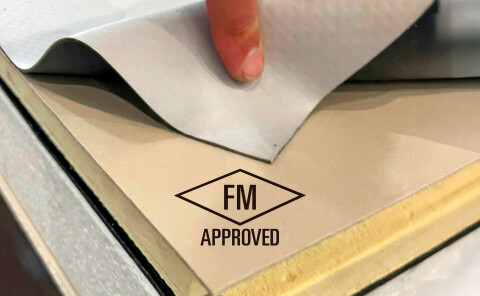
AllShield BarrierSheet is a mineral separation layer positioned directly beneath the waterproofing membrane, between the fire-exposed roof surface and the insulation below. At approximately 2.5 mm thick and 3 kg/m², it provides a dedicated passive fire-protection function with limited additional weight. Unlike an electrical detection or suppression system, BarrierSheet does not require power, sensors, software or activation. Its effectiveness depends on its correct position within the roof assembly, continuity of the layer and appropriate detailing at joints, edges, upstands and penetrations.
BarrierSheet is designed to limit the pathway by which direct flames can reach deeper roof layers. This does not mean that heat transfer is stopped or that damage beneath the separation layer becomes impossible. The distinction is important for evaluating the product: preventing direct flame penetration, reducing fire spread across the waterproofing membrane and preventing thermal damage beneath it are different performance objectives. BarrierSheet addresses a specific part of this fire scenario, supported by independent testing of defined roof constructions.
What the ZAG roof-PV fire tests show
Independent testing at ZAG, the Slovenian National Building and Civil Engineering Institute, examined roof-PV configurations incorporating BarrierSheet. The programme documented its passive separation function against direct flame penetration into lower structural layers under the tested conditions. The observations also recorded thermal effects, including local damage and deformation within the roof constructions. These findings show why the assessment of a fire-protection layer must consider the complete tested assembly rather than a material property in isolation.
The ZAG results provide technical evidence relevant to fire exposure beneath PV installations. They do not establish a universal reduction in fire damage, prove that flames cannot spread across the waterproofing membrane or demonstrate that every roof containing BarrierSheet will achieve the same result. Nor should the ZAG programme be described as an FM Approval or as proof of equivalence with an FM Approved assembly. Both forms of evidence have value, but they serve different technical purposes and must be applied within their respective scopes.
Four forms of fire-performance evidence
| A1 — EN 13501-1 | Reaction-to-fire classification of the BarrierSheet material | Applies to the classified material, not the complete roof construction |
| BROOF(t1) — EN 13501-5 | External fire performance of a defined roof assembly | Applies to the classified configuration and its stated conditions |
| ZAG roof-PV fire testing | Observed flame-penetration behaviour and thermal effects under PV fire exposure | Applies to the tested configurations and documented test conditions |
| FM 4470 / FM 4478 | Approval of specified roof assemblies, including a defined roof-PV configuration incorporating BarrierSheet | Applies to the complete listed assembly and its approval conditions |
From documented fire performance to an informed insurance decision
The evaluation of a commercial roof with PV requires more than selecting a product with a recognised material classification. Risk engineers must understand the proposed roof construction, the location of combustible materials, the PV mounting arrangement and the evidence relevant to the anticipated fire exposure. For a project team, the objective is to assemble a technical case that can be reviewed against the requirements of the building owner, applicable regulations and the insurer. This is where clearly documented performance, supported by the original test and approval reports, becomes commercially valuable.
BarrierSheet is included in a defined FM Approved roof-PV assembly under FM 4470 and FM 4478, identified as RoofNav 568563-0-0. The listed construction combines specified PV modules and mounting components with a mechanically attached single-ply waterproofing membrane, BarrierSheet, FM Approved insulation and a new steel deck. The approval concerns that complete configuration and its stated conditions, rather than BarrierSheet as a universal solution for every roof. For an FM-insured project, the project team must verify whether the intended construction matches the listing and establish how any differences are to be assessed.
Existing commercial roofs require a project-specific approach
Existing roofs present a different design question because their materials and construction were often selected long before rooftop PV was considered. Many lightweight buildings contain PIR or EPS insulation that may still perform its thermal function satisfactorily. Removing an entire roof system simply to introduce an additional fire-protection measure can be disruptive and may add cost, waste and construction complexity. Where the existing roof covering provides a suitable substrate, an overlay incorporating BarrierSheet beneath a new waterproofing membrane may offer an alternative that retains serviceable insulation.
The suitability of this approach depends on the actual roof condition, moisture content, existing materials, structural reserve, compatibility of the proposed layers and the requirements of the roofing system. Additional weight from PV modules, mounting systems and ballast must also be assessed, including concentrated loads at supports. BarrierSheet contributes approximately 3 kg/m² over the area in which it is installed, but that figure cannot be used as the total additional load of the proposed roof and PV intervention. The structural engineer and roof specialist must evaluate the complete design.
Timing is another important consideration. Commercial PV installations are commonly intended to remain in service for decades, while work beneath an installed PV array generally becomes more complicated. This means that an existing waterproofing membrane does not necessarily need to have reached the end of its service life before a building owner considers improving the roof's fire strategy. Where PV is planned, reviewing the roof construction beforehand allows the owner, designer and insurer to consider the necessary measures as part of one coordinated investment decision.
Does documented fire performance guarantee insurability?
Insurers consider more than the presence of a particular product or certificate. Building occupancy, construction, fire prevention arrangements, exposure, business continuity and the proposed roof-PV system may all influence the assessment. Consequently, an A1 material classification, a ZAG fire-test report or an FM Approved assembly does not automatically establish that every building using BarrierSheet will be accepted for insurance. Approval of a defined assembly and acceptance of an individual project are related but separate decisions.
The commercial value of independent evidence is that it gives decision-makers a documented basis for discussion. AllShield can provide the relevant classifications, ZAG fire-test information, FM assembly documentation and installation instructions to support a technical review of the proposed roof construction. Where a project falls outside the scope of an existing classification or approval, that limitation should be identified early and referred to the appropriate technical specialist or risk engineer, rather than treated as an assumed approval.
A lightweight, documented approach to passive fire separation
BarrierSheet brings together several characteristics that are relevant to commercial roof design. Its mineral composition and passive separation function address direct flame penetration at a critical interface within the roof. Its low weight and limited thickness can be important where structural reserve or available detailing height is constrained. Its flexible format allows integration into suitable new and refurbished roof constructions, while independent test evidence provides technical documentation for evaluating performance within defined configurations.
The strength of this combination is not that BarrierSheet eliminates every fire risk or guarantees acceptance by an insurer. It is that the product offers a specific, passive protective function with a relatively low additional weight and a documented technical basis. For building owners, architects, roof consultants and risk engineers, this makes BarrierSheet a relevant design option when a commercial roof with PV requires a carefully considered strategy for the consequences of fire.
Discuss your roof-PV project with AllShield
Whether a project concerns a new commercial building or an existing roof being prepared for solar PV, the starting point should be the actual roof construction and the fire-performance objectives. AllShield's technical team can help identify the documentation relevant to the proposed build-up, review the intended application of BarrierSheet and support discussions with the project team and insurer. This provides a practical route from independent evidence to a well-founded design decision, without treating classification or approval as a substitute for project-specific assessment.
Contact AllShield to request a technical review of your roof build-up.
Passive fire protection for new and refurbished roofs with PV
The right roof assembly for PV and documented fire protection
Flat roofs with solar PV require fire protection that considers the complete roof assembly. AllShield BarrierSheet is our standard solution for new construction and roof refurbishment, installed beneath a new waterproofing membrane. AllShield Blue is a specialist alternative for selected existing roofs where retaining the current waterproofing provides a clear practical advantage.
Do you have any questions for us?
We're here for you!