Discover our fire-protection solutions for roofs with PV
6-10-2026
What happens after ignition in a rooftop PV fire?
PV panels do more than introduce an ignition risk. They change flame behaviour, heat exposure and fire propagation across the roof. FM and ZAG testing shows why the complete roof and PV assembly determines what happens after ignition.
A connector failure, damaged cable or electrical arc may start a rooftop PV fire, but ignition is only the beginning of the fire scenario. Once a fire develops beneath a PV array, the panels change the fire environment above the roof. Flames can be redirected along the roof surface, heat exposure can increase significantly and combustible materials in both the PV system and roof assembly can become involved.
This is why rooftop PV fire safety cannot be assessed by looking at ignition prevention alone. The critical question is what happens after ignition. Does the fire remain local or does the roof assembly provide additional fuel that allows it to develop and spread?
PV panels change how fire behaves on a roof
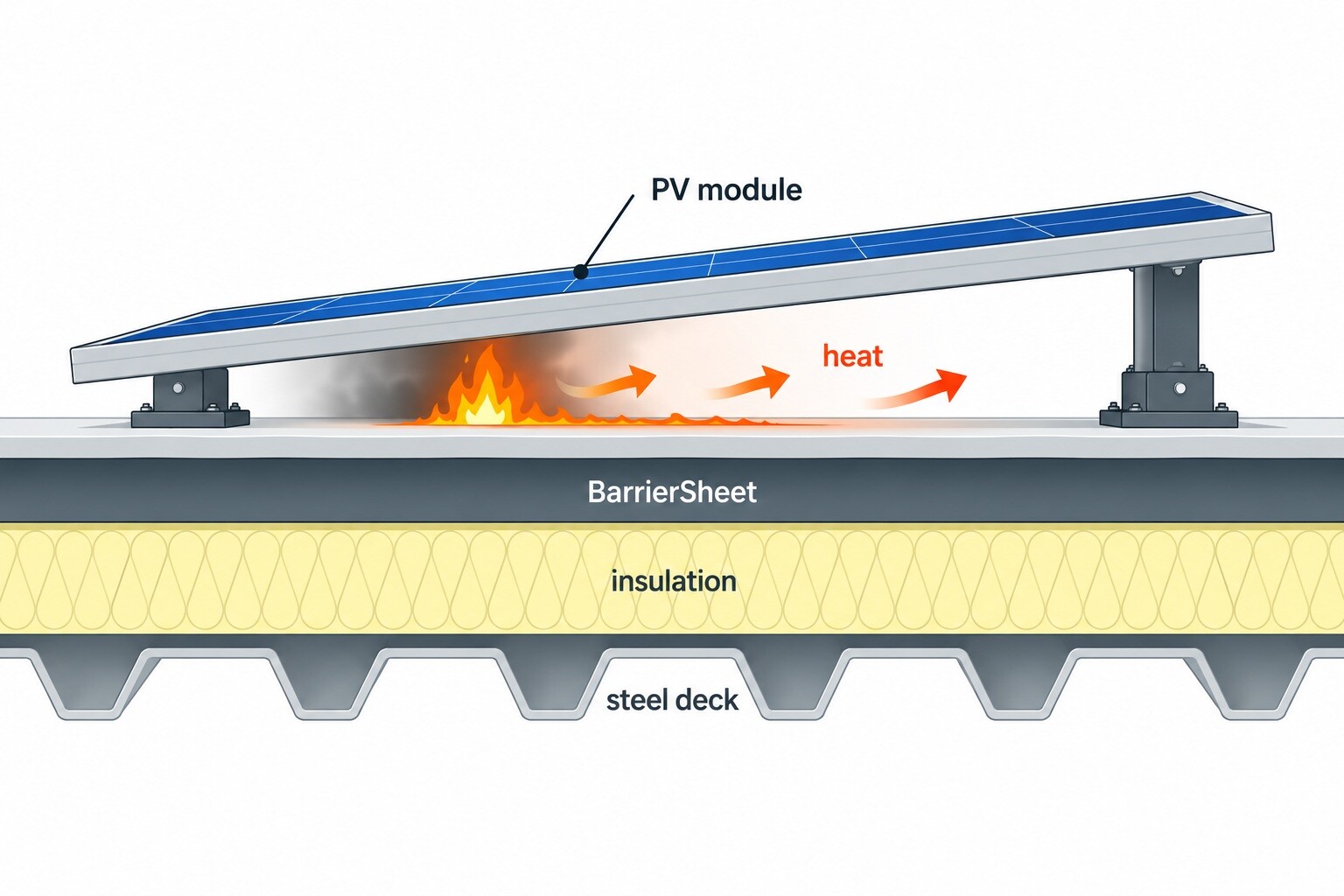
A fire on an open roof and a fire beneath a PV array are not the same fire. Research by FM shows that PV panels can change rooftop fire dynamics in several ways. The cavity between the module and the roof can redirect flames that would otherwise rise away from the surface. Under wind-driven conditions, the flame can be pushed further along the roof. The heated PV module can also radiate heat back towards the roof surface, while combustible components within the module itself can contribute additional fuel.
Plastic backsheets can contribute fuel relatively quickly. Glass-backed modules contain less exposed combustible material but still include components such as adhesives that can become involved when sufficiently heated. The result is a confined fire environment in which the roof can be exposed to more heat over a greater distance than it would be without the PV panel.
The PV cavity can increase heat exposure fivefold
FM quantified this cavity effect during experimental research. At approximately 0.6 metres from the ignition source and at a roof slope of 2.4°, the measured heat flux on the simulated roof was around 4 kW/m² without a PV panel above it. With a simulated PV panel installed above the roof, heat flux at approximately the same position reached around 20 kW/m². In that particular test configuration, the PV cavity therefore increased the measured heat exposure by a factor of approximately five.
The exact values depend on geometry, module height, roof slope, wind conditions and other factors. The important finding is not the factor five itself, but the fact that the presence of the PV module fundamentally changes the thermal exposure experienced by the roof beneath it.
FM also found that module spacing and roof angle influence this effect. In the tested configurations, relatively low slopes combined with effective cavity spacings of approximately 0.13 to 0.25 metres created particularly severe heat exposure. This helps explain why the fire performance of a roof tested without PV cannot automatically be assumed to remain the same after PV modules are installed above it.
More heat means more preheating
Fire does not spread only because flames physically reach the next section of material. Material ahead of the flame is heated before ignition occurs. When heat flux increases, a larger area can be preheated and roofing materials can soften, melt or thermally decompose before visible flames reach them.
The PV cavity can therefore create a feedback mechanism. The module changes the flame geometry, the altered flame increases heat exposure to the roof and the heated roof materials begin to decompose. If the resulting decomposition products ignite, additional energy becomes available to sustain and extend the fire.
The original electrical failure may have been relatively small. The important question is whether the surrounding roof construction allows that small incident to recruit more combustible material.
The roof can become additional fuel
Most commercial flat roofs consist of several layers. A typical lightweight industrial roof may include a waterproofing membrane, PIR or EPS insulation, a vapour control layer and a steel deck.
Under severe fire exposure, some of these materials can melt, deform or thermally decompose. That does not automatically mean that every affected material is actively contributing to the fire in the same way. A material can suffer severe heat damage without becoming a major source of fuel. For fire spread, the more important question is whether flames and heat can continue to access new combustible material and whether decomposition products can feed the fire. This is why the distinction between thermal damage and active fire contribution is important.
The 2026 ZAG Fire Safety Guideline for Building Applied Photovoltaic Systems on Flat Roofs therefore places strong emphasis on the roof construction itself. For new roofs, its primary recommendation is the use of non-combustible insulation. For existing roofs where combustible insulation cannot simply be removed, the guideline states that an alternative mitigation layer can be considered, provided that the complete solution is tested as it will actually be installed. This moves the discussion from individual products to complete roof assemblies.
The roof and PV system must be considered together
A PV system and a roof should not be treated as two separate systems that simply happen to occupy the same space. Once fire starts underneath the array, the different components begin to interact.
The module height and inclination influence flame behaviour. The mounting system influences the geometry of the cavity. The waterproofing membrane is exposed to heat and flame, while the insulation determines how heat moves deeper into the construction and whether additional combustible material can become involved. This is why FM 4478 evaluates the interaction between the PV modules and the complete roof assembly rather than considering only the module or only the roof covering.
FM's own research also concludes that using quality components, good design, correct installation and maintenance can reduce the probability of ignition but cannot eliminate it completely. Prevention therefore remains essential, but it requires a second line of defence. That second line of defence is the roof assembly itself.
What happens when a non-combustible barrier is added?
ZAG investigated this principle in a series of rooftop PV fire tests using AllShield BarrierSheet. The test assemblies included realistic combinations of PVC membranes, PIR, EPS, bitumen and PV modules. Larger ignition sources were deliberately used where necessary to create sustained fire development beneath the PV system.
The tests were not designed to demonstrate that nothing underneath the BarrierSheet would be affected by heat. In fact, the thermal exposure was severe. Temperatures measured directly beneath the BarrierSheet ranged from approximately 430°C to more than 800°C, depending on the test configuration. PIR showed deformation, delamination and decomposition. EPS melted beneath the ignition area in some configurations. Heat therefore clearly penetrated the roof assembly and caused thermal damage.
However, ZAG found an important difference. Across all four test configurations, the AllShield BarrierSheet prevented direct flame penetration into the deeper structural layers. Heat still passed through the system and underlying materials were still affected, but the fire did not gain unrestricted flame access to the combustible layers beneath the barrier. That is the function of a consequence-limiting fire barrier.
Heat damage and fire spread are not the same thing
This distinction is important when interpreting PV fire tests. A fire barrier does not need to keep every material underneath it at room temperature. Its primary function is to control how the fire can develop and which materials can become directly involved.
In ZAG's AS-4 test, all four PV modules became involved and the test continued for 40 minutes. The PIR underneath the BarrierSheet showed substantial thermal damage and discolouration. The damage did not, however, penetrate through the full PIR thickness and the BarrierSheet continued to prevent direct flame penetration into the deeper construction. The PIR was affected by heat, but the open fire above was prevented from obtaining unrestricted access to the deeper layers.
The objective is therefore not to claim that PIR becomes non-combustible. It does not. The objective is to prevent the insulation and deeper roof layers from becoming freely available fuel for the fire above.
Limiting access to fuel changes the consequence
This gives us a practical way to divide rooftop PV fire safety into two parts. The first is ignition prevention. Good components, compatible connectors, correct installation, monitoring, inspection, maintenance and electrical protection all reduce the probability that a fire starts. The second is consequence limitation. If ignition still occurs, the important question becomes how much additional combustible material the fire can access.
Without an effective barrier, the fire may involve the waterproofing membrane and continue into combustible insulation or other roof layers. With a suitable non-combustible layer in the correct position, direct access to those deeper materials can be restricted. The amount of fuel directly available to the flame is then reduced and the roof is less able to become an extension of the original fire. This is the principle behind restricting direct flame access to deeper combustible roof layers beneath PV.
Why not simply replace all combustible insulation?
For new construction, a fully non-combustible roof assembly can be an excellent solution. For existing lightweight industrial buildings, it is often more complicated. Roof structures have limited load capacity. Adding PV already introduces additional permanent load. Replacing lightweight insulation with a heavier non-combustible build-up can consume structural capacity that might otherwise be available for the PV system.
The exact difference depends on the insulation type, thermal resistance, thickness and complete roof design. There is therefore no single kilogram-per-square-metre comparison that applies to every roof.
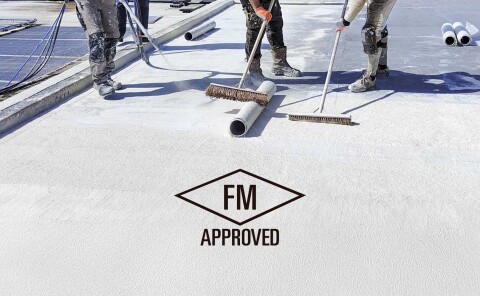
AllShield BarrierSheet is approximately 2.5 mm thick and 3.0 kg/m². It is installed as a mineral coverboard beneath a new waterproofing membrane. This creates another design route: instead of automatically replacing every combustible layer in an existing roof, a lightweight non-combustible barrier can be integrated into a tested roof assembly to separate the fire above from combustible layers below. For lightweight industrial roofs, this can preserve more structural capacity for the PV installation than some heavier roof renovation alternatives.
Complete assembly testing remains essential
Adding any board to any roof does not automatically create a fire-safe PV assembly. The membrane matters, the insulation matters, the joints and fasteners matter and the PV geometry also matters. The position of the fire barrier within the complete assembly is equally important.
The ZAG guideline makes this explicit. Where alternative mitigation solutions are considered instead of non-combustible insulation, they should demonstrate comparable robustness in experiments using the complete roof and PV system as it will actually be constructed and at a scale involving multiple PV modules.
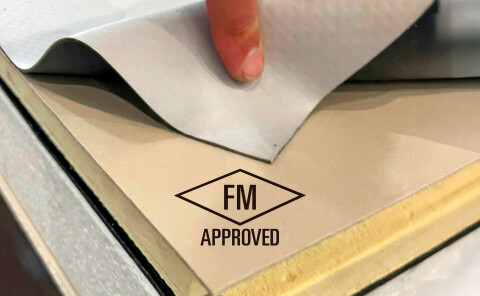
FM follows the same system-based philosophy. AllShield BarrierSheet is FM Approved under FM 4470 and FM 4478 for applicable defined roof assemblies. The FM Approval Report identifies BarrierSheet as a 2.5 mm coverboard and lists the relevant complete assembly in RoofNav. The Approval therefore applies to defined assemblies and installation conditions. It is not a general claim that one component automatically makes every possible roof configuration safe.
After ignition, the roof becomes the second line of defence
PV fire prevention will continue to improve. Better connectors, better installation, arc detection, monitoring and maintenance all reduce the probability of a fire. But eliminating every possible ignition source over the full operating life of a commercial PV system is not realistic. FM states this directly: good products, design, installation and maintenance can reduce ignition likelihood but cannot eliminate it.
A resilient PV fire strategy therefore has to assume that ignition can still occur. Once it does, the question changes from what caused the fire to what happens after the fire has started. The key issue then becomes how much of the roof can become part of the fire.
That is why rooftop PV fire safety requires both prevention and consequence limitation. The electrical system may determine whether the first ignition occurs, but the complete roof and PV assembly determines what happens next.
Technical basis
This article is based on experimental research by FM into rooftop PV fire dynamics and heat flux, FM Approval Standard 4478, the 2026 ZAG Fire Safety Guideline for Building Applied Photovoltaic Systems on Flat Roofs, ZAG report 448/25-560-1-EN on rooftop PV fire testing with AllShield BarrierSheet and FM Approval Report PR472014 for AllShield BarrierSheet.
Passive fire protection for new and refurbished roofs with PV
The right roof assembly for PV and documented fire protection
Flat roofs with solar PV require fire protection that considers the complete roof assembly. AllShield BarrierSheet is our standard solution for new construction and roof refurbishment, installed beneath a new waterproofing membrane. AllShield Blue is a specialist alternative for selected existing roofs where retaining the current waterproofing provides a clear practical advantage.
Do you have any questions for us?
We're here for you!