
Is your commercial roof ready for solar PV?
Is your commercial roof ready for solar PV?
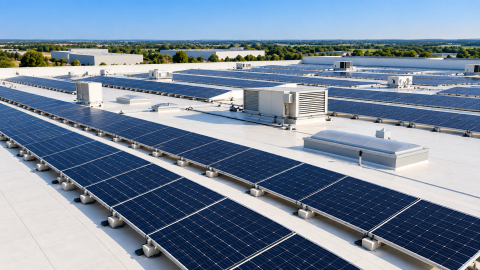
Commercial rooftop PV is often approached as an energy project, but its feasibility starts with the roof beneath it. Structural capacity, remaining service life, roof composition, fire behaviour and insurer requirements all influence whether a PV installation is technically and commercially viable.
Assessing these factors before finalising the PV design helps avoid unexpected roof refurbishment, costly redesign and insurance difficulties. Where an upgrade is required, it also creates an opportunity to integrate lightweight fire protection into a roof assembly designed for the planned PV installation.

How the existing roof influences PV fire risk
Even with high-quality PV components, professional installation and regular maintenance, the possibility of electrical ignition cannot be completely eliminated. What happens after ignition depends partly on the interaction between the PV modules, mounting system, waterproofing membrane, insulation and underlying roof construction.
The objective is therefore not only to reduce the probability of ignition but also to limit the consequences if ignition occurs. This is the principle behind what we refer to as consequence-limiting design: considering how the roof assembly can help limit the consequences of ignition and reduce the likelihood of a local incident escalating into a more extensive fire.
Will your roof last as long as your PV installation?
Commercial PV installations are often planned for 25 to 30 years of operation, while the existing waterproofing membrane may have a much shorter remaining service life. Consider a roof with only ten years of remaining service life. Installing PV now could mean removing and reinstalling the panels and mounting equipment well before the end of the PV system's operational life, creating additional costs, operational disruption and lost electricity production.
Assessing the roof before installing PV creates an opportunity to coordinate roof refurbishment, fire protection and solar installation in one project. The appropriate approach depends on the condition and remaining service life of the existing roof.
If the roof has sufficient remaining service life, the next step is to establish whether its construction and the proposed PV installation meet the relevant structural, fire safety and insurance requirements. Where these are already satisfied, no additional fire protection may be necessary.
If the roof's remaining service life or suitability is uncertain, its condition and technical limitations should be assessed before deciding whether it can be retained or requires refurbishment. Where structural capacity is insufficient, a qualified structural engineer must determine whether the proposed PV installation is feasible and what modifications may be required.
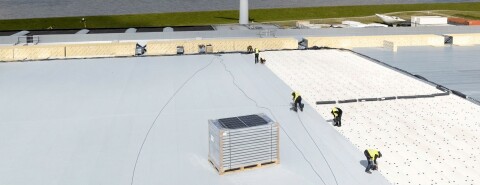
If the roof will not last as long as the planned PV installation, refurbishment before installing PV should be considered. Replacing the waterproofing membrane at this stage can avoid the disruption of a later roof replacement and provides an opportunity to integrate fire protection into the new roof assembly.
For new buildings, these decisions can be made at the design stage. Roof service life, structural capacity, fire performance and PV mounting requirements can be considered together from the outset.
A lightweight fire barrier for PV-ready roofs
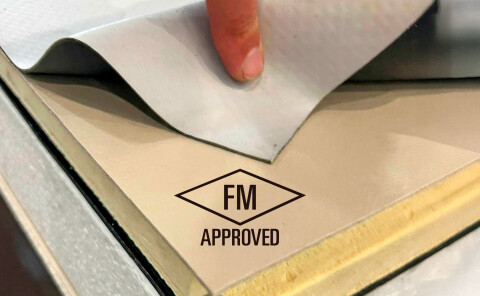
When a new waterproofing membrane is required, roof refurbishment provides an opportunity to address fire performance and structural loading together. AllShield BarrierSheet is our standard solution for integrating a lightweight mineral fire barrier into new or refurbished roof assemblies.
This A1 non-combustible coverboard is installed beneath a new waterproofing membrane and adds approximately 3 kg/m² to the roof. It can be combined with suitable insulation materials, including PIR, within appropriately designed roof assemblies. Its low weight helps preserve available structural capacity for the planned PV installation and depending on the existing roof construction, may reduce the need for structural reinforcement.
AllShield BarrierSheet is FM Approved under standards FM 4470 and FM 4478 for specified roof assemblies, including RoofNav assembly 568563-0-0. The applicable approval and installation requirements must be checked against the complete proposed roof assembly.
Independent PV-related fire testing conducted by ZAG in 2025 demonstrated that BarrierSheet prevented direct flame penetration into deeper structural layers in all four tested configurations. Some underlying materials still experienced thermal damage, highlighting the importance of the entire roof construction. These findings illustrate how a non-combustible barrier beneath the waterproofing membrane can contribute to consequence-limiting design by restricting direct flame access to combustible materials within the roof.
BarrierSheet is not a waterproofing membrane or a structural reinforcement layer. Its suitability and fire performance must always be assessed within the proposed roof assembly, taking account of the insulation, waterproofing membrane, fastening system and planned PV installation.
Technical documentation: FM Approvals report PR472014, covering FM 4470 and FM 4478, and ZAG fire test report 448/25-560-1-EN, available through the AllShield certificates and downloads pages.

When retaining the existing waterproofing is an option
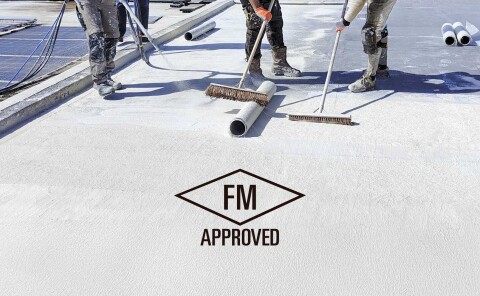
Not every commercial roof requires complete refurbishment before PV can be installed. In selected projects, retaining the existing waterproofing membrane may provide a clear practical or economic advantage. Where the existing roof requires additional fire protection, this can create an opportunity to consider an alternative to installing a new waterproofing membrane.
AllShield Blue is a mineral fire protection coating that can be applied directly to suitable existing waterproofing membranes. It is FM 4484 Approved for specified retrofit roof and PV assemblies. This alternative is intended for projects where the existing membrane is in suitable condition, has sufficient remaining service life and can be retained as part of a roof assembly that meets the applicable technical and insurance requirements.
Application also depends on suitable weather conditions, the regional climate and the availability of specialist applicators. Where the existing roof requires refurbishment or retaining the current waterproofing provides no clear advantage, AllShield BarrierSheet beneath a new waterproofing membrane remains our standard solution.
Contact AllShield to establish whether your existing roof meets the specific conditions for a coating solution and whether Blue is available for your project.
Planning PV on a new commercial roof?
New construction offers the opportunity to consider structural capacity, roof insulation, waterproofing, fire performance and PV mounting requirements as one integrated design. Addressing these requirements from the outset allows the roof to be designed around the planned PV installation rather than requiring modifications after construction.
AllShield BarrierSheet can be specified beneath the new waterproofing membrane as part of a lightweight roof assembly, including suitable systems with PIR insulation. Incorporating the fire barrier at the design stage allows the roofing contractor, PV designer and insurer to review the proposed assembly before construction begins.
Confirm your proposed roof and PV design with your insurer
Before finalising the PV design, establish which fire safety and roof construction requirements your insurer applies. Provide the available details of the existing or proposed roof assembly, including the roof deck, insulation, waterproofing membrane, PV mounting system and relevant fire test documentation.
For FM-insured projects, identify the applicable RoofNav assembly and its conditions. Where the proposed construction differs from a listed assembly, consult the relevant insurer or FM engineer about the required project-specific assessment. Involving these parties early can help prevent costly design changes later in the project.
Suggested wording for your insurer
We are planning a rooftop PV installation and would like to confirm the applicable fire safety and roof assembly requirements before finalising the design. Please advise which technical documentation, fire test evidence and approvals are required for our proposed roof and PV configuration. We can provide details of the existing roof, the proposed refurbishment and the planned PV installation for your review.
Request a roof assembly review for your PV project
Planning a commercial rooftop PV project, roof refurbishment or new building? Share your existing or proposed roof build-up, roof area and project requirements with AllShield. We can review the available technical information and assess whether AllShield BarrierSheet can be integrated into the proposed roof assembly.
For selected existing roofs, we can also establish whether AllShield Blue may be an appropriate alternative. Structural capacity and other project-specific engineering requirements must be verified by the relevant qualified professionals.
Passive fire protection for new and refurbished roofs with PV
The right roof assembly for PV and documented fire protection
Flat roofs with solar PV require fire protection that considers the complete roof assembly. AllShield BarrierSheet is our standard solution for new construction and roof refurbishment, installed beneath a new waterproofing membrane. AllShield Blue is a specialist alternative for selected existing roofs where retaining the current waterproofing provides a clear practical advantage.
Request a roof assembly review