Discover our fire-protection solutions for roofs with PV
9-9-2025
BarrierSheet and Coverboard terminology: what the terms mean
Coverboard, fire barrier board, non-combustible board and roof protection board are often used in the same conversations, but they are not technical synonyms. Understanding the terminology helps designers specify the required function and supporting evidence more accurately.
Why roofing terminology varies
Roof terminology varies by country, profession and project type. A roofing contractor may use the term Coverboard, a fire engineer may refer to a fire barrier and an architect may describe a protection board. Specifications may instead focus on classifications, mechanical properties or system approvals.
These descriptions can overlap, but the name itself does not establish performance. The more useful question is what function the product is expected to perform within the roof build-up and what evidence supports that function.
Coverboard
A Coverboard is generally installed between the insulation and waterproofing membrane. Depending on the product and roof system, it can provide a stable substrate, protect insulation, contribute to mechanical performance or perform a role within the fire strategy.
Different Coverboards can have different composition, mass, mechanical properties and fire performance. Products should therefore be assessed against the functions required by the specific roof rather than assumed to be interchangeable because they occupy a similar position.
Fire barrier and non-combustible terminology
Fire barrier describes an intended function, while non-combustible refers to a material property supported by the relevant reaction-to-fire classification. Where fire performance is part of the specification, the evidence should therefore identify both the product property and, where relevant, the performance demonstrated by the complete roof or roof-PV assembly.
This distinction makes the specification clearer for designers, contractors and insurers and avoids relying on generic terminology as a substitute for technical evidence.
Where AllShield BarrierSheet fits
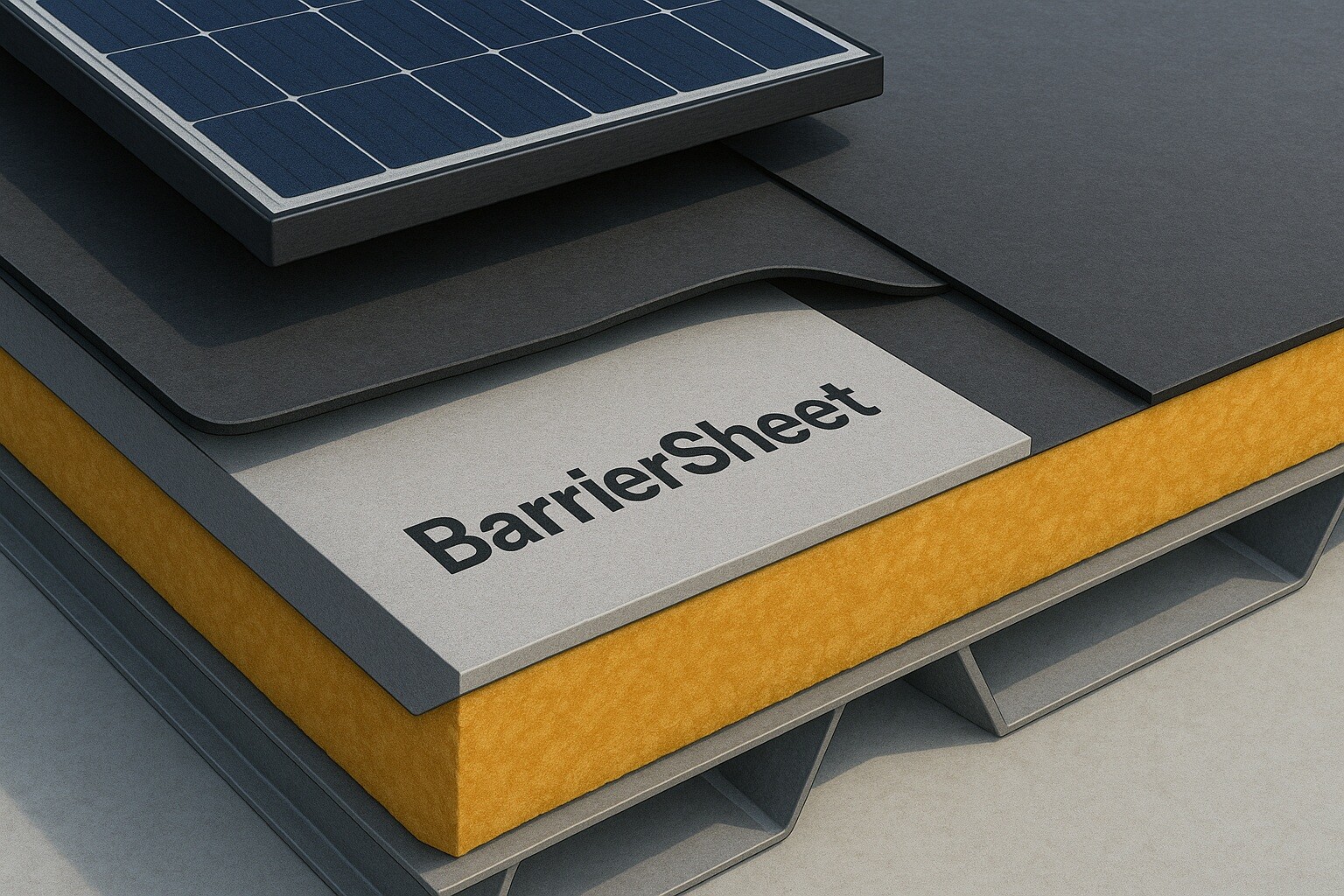
AllShield BarrierSheet is a 2.5 mm cementitious Fire board installed directly beneath the waterproofing membrane. It is classified A1 under EN 13501-1 and weighs approximately 3 kg/m².
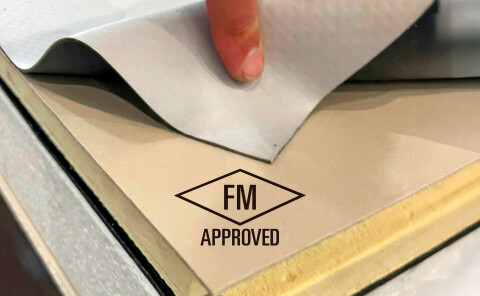
Its evidence exists at several levels. A defined roof build-up incorporating BarrierSheet is classified BROOF(t1) under Efectis Classification Report 2025-Efectis-R000983. ZAG roof-PV testing found that BarrierSheet prevented direct flame penetration into deeper structural layers in the tested configurations, while FM Approval Report PR472014 provides formal coverage for specified roof and roof-PV assemblies.
These pieces of evidence address different questions and should therefore be used according to their scope.
Specify the required performance
A useful specification goes further than simply requesting a Coverboard or non-combustible board. It identifies the required material properties, position in the roof, installation method, relevant classifications or approvals and the system evidence required for the intended project.
This gives roofers, designers, risk engineers and insurers a clearer basis for assessing the proposed construction without making generic comparisons between different Coverboard technologies.
For detailed product information, classifications and current FM documentation, see the AllShield BarrierSheet product page or contact AllShield for the evidence relevant to your project.
Passive fire protection for new and refurbished roofs with PV
The right roof assembly for PV and documented fire protection
Flat roofs with solar PV require fire protection that considers the complete roof assembly. AllShield BarrierSheet is our standard solution for new construction and roof refurbishment, installed beneath a new waterproofing membrane. AllShield Blue is a specialist alternative for selected existing roofs where retaining the current waterproofing provides a clear practical advantage.
Do you have any questions for us?
We're here for you!