Discover our fire-protection solutions for roofs with PV
1-12-2025
BROOF(t1) and rooftop PV: understanding the scope of the classification
BROOF(t1) is important evidence for the external fire performance of a defined roof construction. Rooftop PV introduces a different geometry and exposure above that roof, so conventional roof classification and PV-specific evidence answer different but complementary questions.
What BROOF(t1) demonstrates
BROOF classifications are assigned under EN 13501-5 using the relevant external-fire test methods in CEN/TS 1187. They provide evidence about the external fire performance of the classified roof construction within its stated field of application and are an important part of roof specification.
Rooftop PV introduces a different configuration above that roof. Modules create an air cavity over the waterproofing membrane, can influence heat feedback and flame behaviour and introduce electrical components that may provide an ignition source. A standard external-fire classification and a roof-PV fire test therefore address different exposures.
Efectis Classification Report 2025-Efectis-R000983 assigns BROOF(t1) under EN 13501-5 to a defined roof build-up incorporating AllShield BarrierSheet. The classification applies to that construction and its stated field of application, rather than to BarrierSheet as a universal standalone BROOF(t1) product.
Different evidence answers different questions
| Evidence | What it demonstrates | Scope |
| EN 13501-1 reaction-to-fire classification | Reaction-to-fire behaviour of the classified product | Product-specific |
| BROOF(t1) under EN 13501-5 | External fire performance of the classified roof construction | Defined construction and field of application |
| Roof-PV fire testing | Behaviour of the roof-PV configuration under the tested exposure | Tested configuration |
| FM Approval / RoofNav | Formal approval of the listed roof or roof-PV system | Listed assembly and conditions |
Why PV-specific testing adds information
PV-specific testing can provide information about fire behaviour beneath modules that a conventional roof classification was not designed to reproduce. ZAG testing commissioned by AllShield examined roof-PV configurations with AllShield BarrierSheet beneath the waterproofing membrane and found that BarrierSheet prevented direct flame penetration into deeper structural layers in the tested ZAG configurations.
This evidence should not be viewed as competing with BROOF(t1). The two programmes address different questions and together provide a more complete picture of the roof and roof-PV system.
FM provides a third route
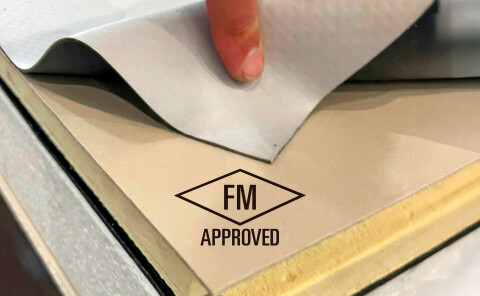
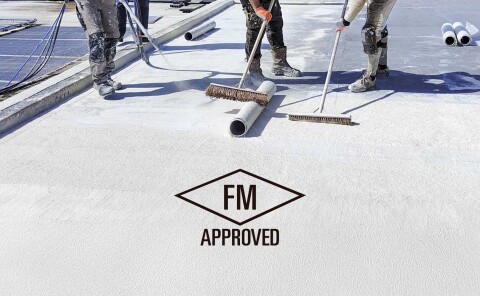
AllShield BarrierSheet is also included in RoofNav assembly 568563-0-0 under FM Approvals Report PR472014, covering FM 4470 and FM 4478. This provides formal approval for the listed configuration.
BROOF(t1), PV-specific testing and FM Approval therefore provide three different forms of evidence: classification of a defined roof construction, experimental evidence for tested roof-PV configurations and formal approval of a listed system.
Match the evidence to the design question
A useful roof-PV assessment starts by defining the fire scenario being considered and then selecting evidence that addresses that scenario. This allows designers, owners and insurers to distinguish clearly between product properties, classified roof constructions, roof-PV fire testing and formal system approval.
For a deeper explanation of these differences, read Olivier Langejan's whitepaper What does a fire test actually prove? If you need help identifying which evidence applies to a proposed commercial roof-PV build-up, contact AllShield.
Passive fire protection for new and refurbished roofs with PV
The right roof assembly for PV and documented fire protection
Flat roofs with solar PV require fire protection that considers the complete roof assembly. AllShield BarrierSheet is our standard solution for new construction and roof refurbishment, installed beneath a new waterproofing membrane. AllShield Blue is a specialist alternative for selected existing roofs where retaining the current waterproofing provides a clear practical advantage.
Do you have any questions for us?
We're here for you!